Now we move on to what, for most, is the main attraction of Kamiak Butte: the south face, resplendent with wildflowers and gazing down upon the gentle undulations of the Palouse.
I'd like to start with some shots that I actually tried twice during my trip. The first I had tried once during midday, with acceptable results. I wanted to try it again, though, with more dramatic lighting, so the following dawn I huffed and puffed back up the hill to the same balsamroot plant. The sunrise lighting wasn't as amazing as I'd hoped, but even the little stripe of pinkish sky in the background livens things up. I used f/25 to maximize my depth of field; a trick to help is to set the focus point behind the foreground rather than directly on it. This helps keep the background sharp.
For the next image, my original results had actually been satisfactory, but not quite good enough. I took the original during the late afternoon, and while the light was starting to get attractive, it was still a bit splotchy and distracting. The next morning, which was overcast after a brief few minutes of sunshine at sunrise, provided more ideal lighting conditions. In post-processing, I would definitely adjust the contrast in the top half of the image to accentuate the Palouse landforms. I used f/32 and set my focus point on the rearmost flowers to keep everything in focus.
The next image, framing desert parsley against the Palouse farmland, was similarly originally taken during too-sunny lighting conditions. Although it took some doing, I was able to locate the exact same group of flowers the next morning. Although this image isn't as striking as the ones above, I still like it. The only problem is that all of the vertical lines are tilted - the flower stems and the tree all point to the left. This gives the picture a bit of a crooked feel, even though I was actually quite careful to keep it level with the horizon. I used f/14 to preserve some detail in the background.
For now, we'll stick with the theme of juxtaposing the Palouse against flowers. I actually really like this image; I think it has a good sense of depth. This would have been better with sunrise lighting, perhaps, but it's still nice. By now, if you've been reading this and other posts carefully, you can predict what I did to keep everything in focus: stopped down to f/29, set my focus point slightly behind the foreground.
The next one actually came from midday, while the sun was shining! Rare, I know. But the sunshine was filtered a bit by high clouds, and illuminated these balsamroot flowers in a surprisingly attractive way. I had to stop down all the way to f/22 to keep some detail in the distant farmland.
The next one captures the vibrancy of the balsamroot flowers. I tried this shot at several different apertures, and the one you see below is at f/13. Even though I actually would have preferred a wider depth of field, my results with a narrower aperture lost so much sharpness to both diffraction and motion blur (the flowers moved ever so slightly in a breeze) that I ended up preferring the (relatively) wider aperture.
Now I'll move on to some more intimate wildflower images. This first one is probably my least conventional composition of the bunch. I stopped down to f/18 so that I could retain some detail in the paintbrush in the background. I don't like the splotchy white areas in the background, but otherwise, I think this was a neat idea. You'll see more compositions with a similar concept in future posts...
More paintbrush and desert parsley, this time in a more conventional format. This time, I used f/3.3, since the objects were all much closer to each other and because I was much less concerned with preserving background detail.
Another nice portrait follows below, this one of a larkspur of some sort. This one was actually a bit of a challenge, if only because a lot of these plants looked rather motley, and it took a while to spot one that both looked nice and was at a good height given my tripod coverage. I like this composition because the background flowers on either side provide a bit of symmetry.
This one captures some paintbrush that had just begun to bloom. The first time I tried to photograph these flowers, it didn't work - it was sunny and about noon at the time, and the only way to manage the lighting well was to shade them with my body. I was unable to do both that and actually compose the shot (I had to set the camera up on my baby tripod, and thus needed my body to be rather low to the ground). The second time I passed the flowers, though, they were shaded. I used f/3.3, and even at that wide aperture the background is still a bit distracting. I think the diagonal color change is also distracting in and of itself.
Finally, I'll close with the theme on which this post began: sunrise lighting. I'm posting this one last because, even though I like it, it needs quite a bit of work. Even using a graduated neutral density filter, the trees are too dark. They aren't so far gone that some work in Lightroom couldn't bring them out, though. And the skies and meadows aren't too bad. I used an aperture of f/16 to keep everything in focus; I was far enough away from the meadow that I didn't need to use anything narrower.
Monday, May 20, 2013
Kamiak Butte, Part 1: The Forest
Kamiak Butte is truly a special place. One needs merely to glimpse it to realize this, for even this glimpse will reveal its tree-clad slopes protruding oddly above the gently rolling plains of the Palouse. It exists as a geological relic of an earlier time. The rolling hills of the Palouse consist of windblown deposits. Kamiak Butte, on the other hand, consists of quartzite from an earlier geologic period.
It's a particularly special place because the steepness of its topography relative to its surroundings and its east-west orientation (creating distinct northern and southern sides) allow the butte to sustain multiple distinct ecosystems. The north side, which receives comparatively little direct sunlight (especially during the winter months) accumulates a great deal of snow, which melts slowly throughout the early spring. Moisture of any kind is retained here longer than on the sunny south side. By summertime, the south side is too dry to support much of a forest. Instead, it is carpeted by grassy meadows, dotted only with occasional groves of pine and shrubs. It is this south side that is the star of the show, with extravagant flowers and sweeping views of the Palouse.
The forest, too, was beautiful in its own right, and in fact featured a floral show just as diverse as that on the ridgetop, if less ostentatious. The tree cover consists mostly of ponderosa pine, with a smattering of fir, larch, aspen, and other trees thrown in for good measure. Mallow ninebark, the dominant shrub throughout most of the forest, was just beginning to show some white blossoms, and profuse wildflowers carpeted the forest floor. Even with basically four days in the park, I only had time to photograph a small minority of the species in bloom.
This post focuses on my photography in the forested areas of the park. The next post will feature the meadows.
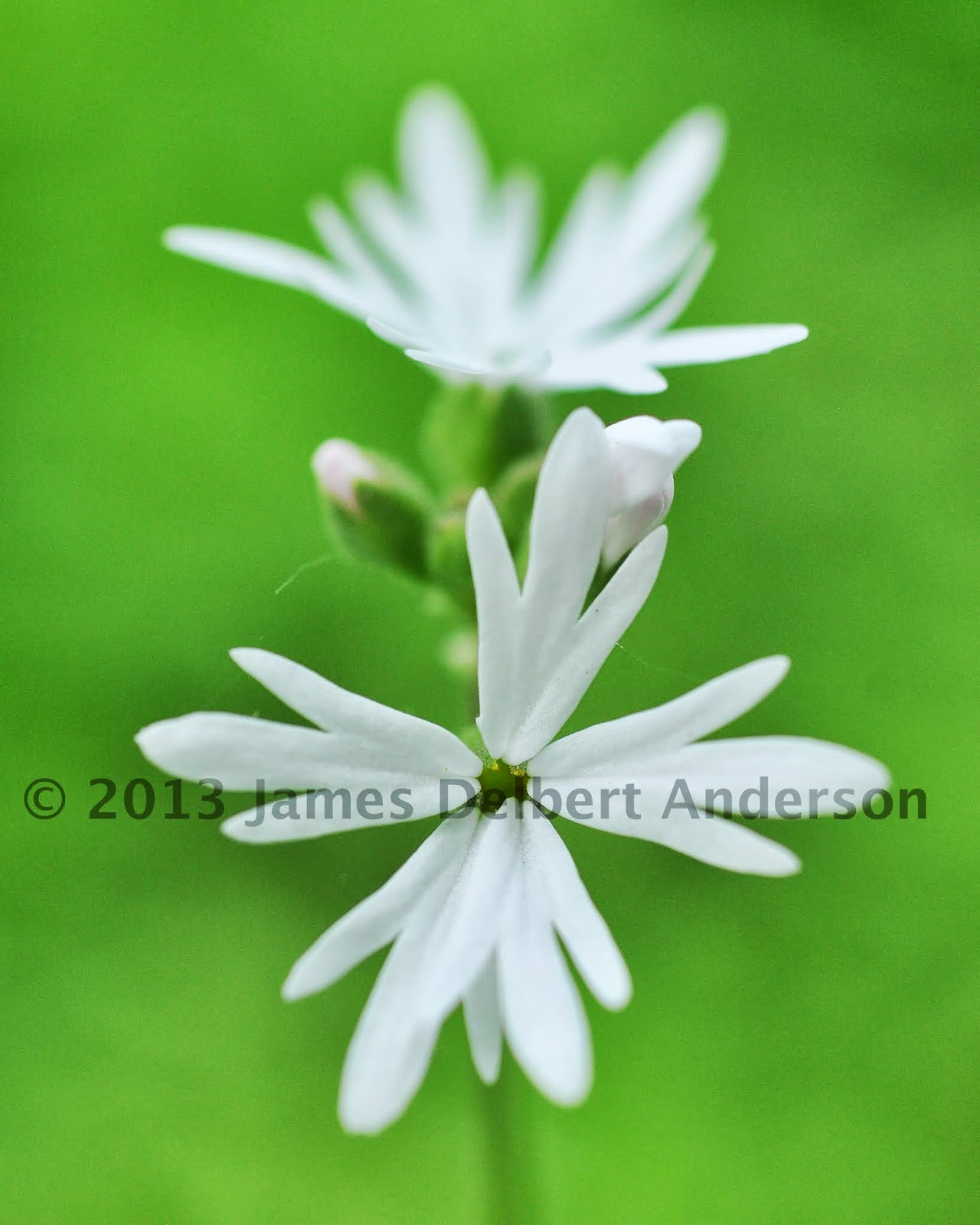
We'll start with star-flowered false Solomon's seal (what a mouthful!). I like this composition because it's nearly symmetrical, with attractive lines formed by the leaves. I used f/3.8 to keep the background simple. (You may notice that my wide apertures differ in some of my pictures; this is because, for complicated physical reasons, my macro lens' maximum and minimum apertures vary at different focusing distances. My other lenses similarly differ at different focal lengths. There are fixed-aperture lenses, but sadly they are more expensive).
Next, a flower that I saw for the first time: ballhead waterleaf. They bloom pretty low to the ground, but their purple color helps them to stand out. I actually really like this composition. It keeps the flower at eye level, and having the flower cluster partially obscured by a leaf adds some depth. It is almost as if the flower is shy, and peeking out from behind its leaves. I used an aperture of 3.5 to minimize background distractions.
Next comes another flower I encountered for the first time: Western meadowrue. The reason it was striking was that its flowers seemed to resemble jellyfish, especially the way the hanging stamens danced about in even slight breezes when the rest of the plant was still. Thankfully, I was able to photograph this flower on a relatively calm morning, enabling me to get even the stamens sharp. I stopped down to f/9 to keep some discernible detail in the stamens of the out-of-focus flowers. The background green is a bit splotchy, but I had to accept it because this specimen had more attractive blooms than any other meadowrue that I had seen on any of the trails.
Ponderosa pines, although they look cool in their context, don't necessarily top my list of the region's most attractive trees. My brother noticed an interesting phenomenon, however - the emerging cones, or whatever these are, actually look quite pretty. I used f/4 because I thought the narrower depth of field would make the image more dramatic, and prevent too much distracting detail in the surrounding needles. Kudos 24/7 to Julian for noticing this!
In a few spots, miner's lettuce carpets the forest floor. I struggled to devise a composition that depicted this without becoming overly busy or complex. What you see below represents my best result along these lines. I used f/8 to keep some detail in the leaves underlying the buds. Had the flowers been blooming already, the image would have been more spectacular, but the leaves below would have been perhaps less discernible.
Confusingly, the flower below can be referred to both as "woodland star" and "prairie star." It occurs in both places, I guess, but that's the trouble with common names. I found this particular specimen in the forest. I used f/5.6 to compromise between background blur and keeping some discernible detail in the flower.
Below is a detail of a mallow ninebark just beginning to flower. I used for f/5.6 for reasons similar to the above picture. Yes, the background is a bit splotchy. But this was the most attractive flower/bud cluster that I saw.
Below is false Solomon's seal (not to be confused with star-flowered false Solomon's seal). It grew very thickly in some places, and I wanted to capture that. The image below doesn't have as much depth as I would have liked, although viewing it at a larger size might help.
I'll end with a sunset image; I took it near our campsite, where the forest borders farmland. Primarily, I wanted to capture the way the late evening sunlight casts shadows over the Palouse's rolling hills, accentuating their contour. This phenomenon actually doesn't come out all that strongly in the image below, but I still like it due to the colorful clouds and the warm color of the sunlight on the tree.
Shortly I will post the second half of my Kamiak Butte pictures, the ones from the meadows! Until then, cheers!
It's a particularly special place because the steepness of its topography relative to its surroundings and its east-west orientation (creating distinct northern and southern sides) allow the butte to sustain multiple distinct ecosystems. The north side, which receives comparatively little direct sunlight (especially during the winter months) accumulates a great deal of snow, which melts slowly throughout the early spring. Moisture of any kind is retained here longer than on the sunny south side. By summertime, the south side is too dry to support much of a forest. Instead, it is carpeted by grassy meadows, dotted only with occasional groves of pine and shrubs. It is this south side that is the star of the show, with extravagant flowers and sweeping views of the Palouse.
The forest, too, was beautiful in its own right, and in fact featured a floral show just as diverse as that on the ridgetop, if less ostentatious. The tree cover consists mostly of ponderosa pine, with a smattering of fir, larch, aspen, and other trees thrown in for good measure. Mallow ninebark, the dominant shrub throughout most of the forest, was just beginning to show some white blossoms, and profuse wildflowers carpeted the forest floor. Even with basically four days in the park, I only had time to photograph a small minority of the species in bloom.
This post focuses on my photography in the forested areas of the park. The next post will feature the meadows.
We'll start with star-flowered false Solomon's seal (what a mouthful!). I like this composition because it's nearly symmetrical, with attractive lines formed by the leaves. I used f/3.8 to keep the background simple. (You may notice that my wide apertures differ in some of my pictures; this is because, for complicated physical reasons, my macro lens' maximum and minimum apertures vary at different focusing distances. My other lenses similarly differ at different focal lengths. There are fixed-aperture lenses, but sadly they are more expensive).
Next, a flower that I saw for the first time: ballhead waterleaf. They bloom pretty low to the ground, but their purple color helps them to stand out. I actually really like this composition. It keeps the flower at eye level, and having the flower cluster partially obscured by a leaf adds some depth. It is almost as if the flower is shy, and peeking out from behind its leaves. I used an aperture of 3.5 to minimize background distractions.
Next comes another flower I encountered for the first time: Western meadowrue. The reason it was striking was that its flowers seemed to resemble jellyfish, especially the way the hanging stamens danced about in even slight breezes when the rest of the plant was still. Thankfully, I was able to photograph this flower on a relatively calm morning, enabling me to get even the stamens sharp. I stopped down to f/9 to keep some discernible detail in the stamens of the out-of-focus flowers. The background green is a bit splotchy, but I had to accept it because this specimen had more attractive blooms than any other meadowrue that I had seen on any of the trails.
Ponderosa pines, although they look cool in their context, don't necessarily top my list of the region's most attractive trees. My brother noticed an interesting phenomenon, however - the emerging cones, or whatever these are, actually look quite pretty. I used f/4 because I thought the narrower depth of field would make the image more dramatic, and prevent too much distracting detail in the surrounding needles. Kudos 24/7 to Julian for noticing this!
In a few spots, miner's lettuce carpets the forest floor. I struggled to devise a composition that depicted this without becoming overly busy or complex. What you see below represents my best result along these lines. I used f/8 to keep some detail in the leaves underlying the buds. Had the flowers been blooming already, the image would have been more spectacular, but the leaves below would have been perhaps less discernible.
Confusingly, the flower below can be referred to both as "woodland star" and "prairie star." It occurs in both places, I guess, but that's the trouble with common names. I found this particular specimen in the forest. I used f/5.6 to compromise between background blur and keeping some discernible detail in the flower.
Below is a detail of a mallow ninebark just beginning to flower. I used for f/5.6 for reasons similar to the above picture. Yes, the background is a bit splotchy. But this was the most attractive flower/bud cluster that I saw.
Below is false Solomon's seal (not to be confused with star-flowered false Solomon's seal). It grew very thickly in some places, and I wanted to capture that. The image below doesn't have as much depth as I would have liked, although viewing it at a larger size might help.
I'll end with a sunset image; I took it near our campsite, where the forest borders farmland. Primarily, I wanted to capture the way the late evening sunlight casts shadows over the Palouse's rolling hills, accentuating their contour. This phenomenon actually doesn't come out all that strongly in the image below, but I still like it due to the colorful clouds and the warm color of the sunlight on the tree.
Shortly I will post the second half of my Kamiak Butte pictures, the ones from the meadows! Until then, cheers!
Thursday, May 16, 2013
Garden, Pt 1
I recently went on a camping trip, and the pictures are going to take a while to sort through and write about. But in the meantime, I can break the silence by posting a few pictures I've taken recently in our garden at home.
Garden photography has some obvious advantages - dependably big, showy subjects that are easily and quickly accessible. It has some challenges, too. One is tripod coverage, because most garden subjects will be low to the ground.
But the biggest challenge, in my experience, is background management. While background management is certainly not always easy in the wild, there are a few variables on the side of the photographer. A good background is more likely to present itself - a carpet of moss, a tree or grove of trees, flowers, a stream, a mountain, a view, a picturesque boulder...the list goes on. In a garden, fences, dirt, walls, and other such elements are often nearby and, in a closeup shot, can create an unattractive and distracting background.. You will see that I have not completely satisfied with my efforts to meet this challenge - two out of three pictures have backgrounds that I find distracting. I thought it would be useful, though, to post them and talk about their positive and negative aspects.
The second, of bleeding hearts, is more recent. The background consists of the plant's leaves and the ground. I am not fully satisfied with the background in the picture, as it's a bit cluttered. The flowers are striking, though, and I like the way I arranged them, with one of the middle ones in focus. That decision, I think, adds depth and interest to the image.
Finally, another picture in which I was able to use multiple flowers of the same kind as a background. The plant was thick enough that I was able to do so without incorporating any distracting elements such as a wall, dirt, or anything else. I tried several different focus points on the flower, and this was the most pleasing. I stopped down to f/6.3 to increase the amount of the foreground flower that was in focus. In hindsight, I wish I had experimented with a slightly wider aperture to see if I could blur the background a bit more without losing too much foreground detail. Ultimately, though, f/6.3 produced an acceptable result, I think.
Garden photography has some obvious advantages - dependably big, showy subjects that are easily and quickly accessible. It has some challenges, too. One is tripod coverage, because most garden subjects will be low to the ground.
But the biggest challenge, in my experience, is background management. While background management is certainly not always easy in the wild, there are a few variables on the side of the photographer. A good background is more likely to present itself - a carpet of moss, a tree or grove of trees, flowers, a stream, a mountain, a view, a picturesque boulder...the list goes on. In a garden, fences, dirt, walls, and other such elements are often nearby and, in a closeup shot, can create an unattractive and distracting background.. You will see that I have not completely satisfied with my efforts to meet this challenge - two out of three pictures have backgrounds that I find distracting. I thought it would be useful, though, to post them and talk about their positive and negative aspects.
The first picture, of Lenten roses, comes from March. I wanted to "frame" the flower in the foreground with the blooms you see above and behind it. They don't stand out as well as I had envisioned, though, and the whole image looks a bit cluttered. This even with the wide aperture of f/3.2. Still, I achieved good detail on the foreground flower.
The second, of bleeding hearts, is more recent. The background consists of the plant's leaves and the ground. I am not fully satisfied with the background in the picture, as it's a bit cluttered. The flowers are striking, though, and I like the way I arranged them, with one of the middle ones in focus. That decision, I think, adds depth and interest to the image.
Finally, another picture in which I was able to use multiple flowers of the same kind as a background. The plant was thick enough that I was able to do so without incorporating any distracting elements such as a wall, dirt, or anything else. I tried several different focus points on the flower, and this was the most pleasing. I stopped down to f/6.3 to increase the amount of the foreground flower that was in focus. In hindsight, I wish I had experimented with a slightly wider aperture to see if I could blur the background a bit more without losing too much foreground detail. Ultimately, though, f/6.3 produced an acceptable result, I think.
Tuesday, May 07, 2013
The Other Spring, Pt. 2
This weekend, I visited a place very similar to the place I described in my last post - Washington Park in Anacortes, which is near Deception Pass and whose forests and south-facing rocky meadows share similar characteristics. The southern parts of the park are the highlight, with trails that meander through flowery meadows and feature grand views of Burrows Channel, Burrows Island, the Puget Sound, and the Olympic Mountains. And although the trip was not the bonanza of show-stopping images that the Deception Pass hike was, I did get a few nice ones.
This first one features death camas and the view out to Burrows Channel and Burrows Island. I really like the warm side lighting that this image captures. An aperture of f/6.3 provided a good compromise between selective focus and keeping enough definition in the background to give it a discernible form. It could use a bit of contrast tweaking, but it's alright.
This one is of field chickweed, I think. I liked the backlighting that was falling on the flowers. I used f/5; narrower apertures added too much distracting detail, and wider apertures lost too much detail in the in-focus flower. I'll be interested to see what I can do with the lighting and color in this shot in post-processing.
Did you notice a theme? There were several pictures for which I said some contrast post-processing work would be required. This is what happens when you photograph on a sunny day. The lighting is much harder to manage! Additionally, I've realized that you have to be more intentional about how you use lighting. On an overcast day, you can just compose your shot without worrying about it very much, and the lighting brings out the subject. On a sunny day, though, you have to make lighting a "character" in the scene; if you don't use it intentionally, it obscures your subject.
This next one features a much more intimate perspective of death camas. Despite the selective-focus appearance, I used f/18 to keep a bit of definition in the coastline in the background. I think it needs some lighting and contrast work; the filtered sunlight (the sun was partially behind a tree) isn't all that flattering with the blue sky and water in the background. We'll see what happens in editing.
This one was a flower I found growing in the forest. Unlike calypso orchids (see below), which I found throughout the park, I only found this flower once. It was a tricky character to identify, but I think it is spotted coralroot. My plant book says it is "widespread"; I've never seen it outside of the mountains, but my travels are just beginning! I'm finding more and more, though, that native biodiversity has taken a hit near populated areas, and plants that should be widespread can only be found in outlying areas like the mountains, or other areas where there has either been relatively less disruption to the ecosystem or a strong effort to preserve and/or restore it.
The picture uses an aperture of f/5; I wanted some definition in the foreground but anything more than f/5 would have made the background too splotchy. It is already borderline too splotchy; the flowers, unfortunately, were on a rocky and awkward slope near a tree, not giving me much flexibility in choosing where to set up the shot.
The next one is of a calypso orchid, a small and easy-to-miss flower that grows under forest cover. I've never seen them in parks in and around Seattle; apparently, the plant used to be more widespread but is easily killed by trampling or picking. The picture's not quite as sharp as I would have liked, but I really like the sunlit background; I think it creates an interesting, moody atmosphere, without being quite so bright as to distract from the flower itself. Obviously for this one I needed to maximize selective focus, so I opened up to f/4.2.
This one is of field chickweed, I think. I liked the backlighting that was falling on the flowers. I used f/5; narrower apertures added too much distracting detail, and wider apertures lost too much detail in the in-focus flower. I'll be interested to see what I can do with the lighting and color in this shot in post-processing.
Finally, some sea blush growing between some reddish rocks. I tried a few different apertures; f/8, which you see below, provided the most satisfying image. This one isn't a show-stopper, I don't think, but it pleasantly depicts a flower in its context at eye level.
Did you notice a theme? There were several pictures for which I said some contrast post-processing work would be required. This is what happens when you photograph on a sunny day. The lighting is much harder to manage! Additionally, I've realized that you have to be more intentional about how you use lighting. On an overcast day, you can just compose your shot without worrying about it very much, and the lighting brings out the subject. On a sunny day, though, you have to make lighting a "character" in the scene; if you don't use it intentionally, it obscures your subject.
Tuesday, April 30, 2013
The Other Spring
In a few hidden pockets of Western Washington, though, a different spring exists - one characterized by sweeping views of the sky and open, grassy meadows bursting with a kaleidescope of wildflowers. One such place is Deception Pass State Park; this past weekend, I visited the Goose Rock and Lighthouse Point trails. They pass through a variety of ecosystems, including rocky meadows. Ultimately, I didn't escape the rain, but it was still an experience radically different from this year's spring photo trips to date.
According to signs at Goose Rock, its meadows exist because retreating glaciers scraped the hills down to bedrock, and plants grew as soil gradually accumulated. I have read in other places that thin, rocky soil precludes the growth of trees and large, woody plants due to the lack of water retention throughout the year (very little rain falls during the summer); I would assume that the same principle holds true here. This, in addition to the northward direction of glacial retreat, helps explain why these meadows particularly exist on sunny southern slopes. You can see this on Google Earth - check out Goose Rock, Rosario Head, Burrows Island, and Fidalgo Head to see this phenomenon at work.
Let's move on to some pictures! As usual, I'm going to start with my favorites. This first one features some variety of desert parsley, a flower that I saw several times last year but never photographed in its own right. This first composition ran the risk of being too busy, but at f/4 I was able to eliminate enough background detail to keep the composition harmonious. I like the vertical lines of the grass against the horizontal lines created by the flower clusters.
Next, a few camas shots that I like. Camas are native and grow in spring-wet, summer-dry meadows in the region; their bulbs are not only edible but were a staple for the diets of many First Nations in the Pacific Northwest. They were so valuable, in fact, that some groups periodically burned meadows to prevent forest encroachment and maintain a favorable habitat for the camas.
The first images comes from the Lighthouse Point trail; the yellow flowers in the background are buttercups and desert parsley. I used f/5.6 - not quite the widest aperture, because I didn't want to lose quite that much detail in the foreground flower. In this case, f/5.6 still provided satisfactory background blur.
The second comes from the summit of Goose Rock. I like the simplicity of the composition and the loneliness of the flower; I only wish I had used a wider aperture (f/5.6, what I used, is pretty wide, but I could have used even a bit less detail in the background). Still, I like how it turned out.
This final camas shot also came from the Lighthouse Point area; one of its large rock faces is in the background. As in an earlier shot, I like the contrasting line directions; the camas stem is straight up, but the grass and rock slope are diagonal, as are the desert parsley flower clusters. I think this adds depth to the composition. I actually stopped down all the way to f/10, so that the flowers and rocks in the background wouldn't be totally formless; I had tried a wider aperture but didn't like it.
...And then there was this plant, which I don't think I've seen before. I'm thinking it's a meadow death camas. It's called "death camas" because its poisonous bulbs closely resemble the edible bulbs of the camas. I like this picture because the out-of-focus yellow flowers in the background give it an interesting texture, I think. I stopped down to f/9 to maintain plenty of detail in the flower cluster itself, and to keep the background flowers a bit more distinct.
There were also some paintbrush blooming around Goose Rock (I think these are harsh paintbrush). For this picture, I used f/7.1. In hindsight, I wish I had used a wider aperture to reduce the background splotchiness. It doesn't kill the composition, but it makes it less compelling than it should be. Still, I like it, and the diffuse backlighting makes the flowers seem luminescent against the shaded background.
This shot of desert parsley isn't as captivating as the first, but I thought I'd post it. I think the aperture of f/5 that I chose serves it well.
Although most of my photographs came from the meadows, I did take a few in Deception Pass's forests. The first features the flowers of what I believe to be red elderberry, with a Douglas fir trunk in the background. I used f/9 to keep the trunk and flowers in the background discernible.
The next one features a blooming madrone (arbutus) tree. I have never seen one of these trees with such picturesque blossoms. They usually look pretty scraggly, even in the spring. I would have liked to try out some pictures closer to the tree, but alas, I could not have done so without trampling the meadows. The picture was more difficult to take than it looks - to get both the madrone and the firs in the background in focus, I had to stop all the way down to f/20 and set the focus point between them (intentionally rendering them both blurry in the viewfinder, which is always an interesting experience).
Finally, some shoots of new growth on a salal plant. This picture uses f/4; I had one with a slightly wider aperture that I liked better but in it the foreground didn't end up sharp for some reason. Still, kind of a cool scene, even if the background gets a bit distracting.
Before I sign off, I'll just say a word about a couple pieces of equipment (besides camera and lenses, of course) without which many of today's pictures would have been painful and/or impossible to take. The first was my small tripod, whose legs are only a few inches long and can be spread out so that the camera's point of few is only a few inches above the ground. The second was a viewfinder attachment that allows me to look through the viewfinder at right angles to my camera. Thus, if I have my camera flat close to the ground, I can point this attachment straight up and look through the viewfinder through this attachment rather than having to get my eyes down to the camera's level. This saves my body a lot of wear and tear on the trail!
Alright, we're done! Bonus points to anyone who actually read the entire post...!
Sunday, April 21, 2013
Stillaguamish Spring
There are different ways to enjoy rivers on foot in the Puget Sound. One is more classic hiking trails that feature big rocks, narrow canyons, big trees and crashing rapids. Another is via walking trails, sometimes in parks and sometimes not, in a more pastoral setting. The rivers are broad and pass through majestic colonnades of cottonwood and alder. River Meadows County Park, in Snohomish County near Arlington, fits into the latter scenario.
The park adjoins the South Fork Stillaguamish River, with broad lawns, grassy meadows, and cheery deciduous forests. The morning featured frequent rain showers - not downpours, but enough to be a nuisance. But, happily, the rain cleared up for a few hours, and there were even a few minutes of "sunshine" (brighter clouds) before they darkened again and rain resumed.
I'll start things off with my most interesting two shots. The first is of Pacific bleeding heart. The selective focus of the image belies the aperture I used - no less than f/18! I didn't want the trees in the background to be a formless blur; I wanted to put the flowers in some context. Since I was already so close to them, I needed to stop that far down to get it.
This second combines salmonberry flowers with a nice view of the river. As in the last picture, for similar reasons (even though I was not quite as close to the subject), I used an aperture of f/18 to make the river and trees in the background discernible.
The rest of the images are experiments, the results of which I consider to be less than stellar but still worth posting.
Bleeding heart, once again f/18 (this seems to have been the aperture of the day!). I want to capture the sweep of a large cluster of the flowers.
In the next two, I attempted to capture the contrast between alder leaves, which are green, and cottonwood leaves, which are much more yellowish early in the spring. I used very narrow apertures for both (f/22 and f/32, respectively) to maximize depth of field. I'm not sure how compelling the compositions are, but the color contrast comes through. I took a vertical version of the last picture, to conform more to the contour of the alder in the foreground, but liked the horizontal version better.
That's all for now, folks. Perhaps the advertised nice weather this week will provide some sunrise/sunset opportunities; otherwise, next weekend will bring more adventures. Cheers!
Wednesday, April 03, 2013
The Trouble With Trillium
This past weekend, I made an early morning trip to Cougar Mountain, the Wilderness Creek trail in particular (I explored a couple others, ultimately, but all of my pictures came from the former). Spring has sprung, with even some trillium flowers beginning to pop up! The majority have not, but a few are brightening the forest. They were joined in a few places by some sort of yellow violet, with maroon lines on the petals (unfortunately, no pictures turned out).
I actually found it quite difficult to take satisfactory pictures of the trillium flowers, despite their seemingly very picturesque qualities. The troubles were twofold as follows.
• Technical: The trillium flowers all fell in my tripod coverage's gap. I have a small tripod that's only a few inches high, and a large tripod that ranges from about six feet down to about one foot. The trillium flowers were taller than my small tripod, and too short to photograph with my large tripod (at least with the compositions I had in mind - none of the flowers that morning lent themselves well to a birds-eye-view perspective). The first shot I am posting I took with my small tripod, but with the legs bunched together to add height. The second shot was handheld. In both cases, I lost the tripod stability that I prefer, thus losing some sharpness. To bump up shutter speed, had to boot up the ISO to 500, which adds some noise, and underexpose slightly, which worsens that problem.
• Compositional: Careful readers of this blog will remember my discussion of the difficulties with flower portraits. How do you place the flower either in an interesting context or present it in a compelling way, that's not just a flat picture of the flower? Context was hard with the trilliums, as the forest floor was still rather brown and cluttered, and the trees were sunlit and thus too contrasty. Also, trillium flowers are so perfectly shaped - with three nearly identical petals immediately above three nearly identical leaves - that they are hard to present in a manner more interesting than a straight-on, top-down shot.
By far my most interesting composition of the morning was of an opening trillium, with the two leaves in the background cradling the bud (this was the only flower I saw that morning that had its leaves arranged in this way). It's not as sharp as I prefer, but I think it might be adequate, and anyway, it's an interesting composition. Dost ask which aperture I used? F/4.5. I started with a narrower aperture, because I wanted more detail in the bud, but this cluttered up the background too much.
This next was the best of my trillium portraits, both compositionally and technically in terms of sharpness. Since I wasn't directly in front of the plant, and since the flower came out diagonally a bit relative to the leaves, the photograph has a side perspective and off-center subject placement that I've found difficult to do convincingly with other trillium shots.
Happy April! Until next time...
I actually found it quite difficult to take satisfactory pictures of the trillium flowers, despite their seemingly very picturesque qualities. The troubles were twofold as follows.
• Technical: The trillium flowers all fell in my tripod coverage's gap. I have a small tripod that's only a few inches high, and a large tripod that ranges from about six feet down to about one foot. The trillium flowers were taller than my small tripod, and too short to photograph with my large tripod (at least with the compositions I had in mind - none of the flowers that morning lent themselves well to a birds-eye-view perspective). The first shot I am posting I took with my small tripod, but with the legs bunched together to add height. The second shot was handheld. In both cases, I lost the tripod stability that I prefer, thus losing some sharpness. To bump up shutter speed, had to boot up the ISO to 500, which adds some noise, and underexpose slightly, which worsens that problem.
• Compositional: Careful readers of this blog will remember my discussion of the difficulties with flower portraits. How do you place the flower either in an interesting context or present it in a compelling way, that's not just a flat picture of the flower? Context was hard with the trilliums, as the forest floor was still rather brown and cluttered, and the trees were sunlit and thus too contrasty. Also, trillium flowers are so perfectly shaped - with three nearly identical petals immediately above three nearly identical leaves - that they are hard to present in a manner more interesting than a straight-on, top-down shot.
By far my most interesting composition of the morning was of an opening trillium, with the two leaves in the background cradling the bud (this was the only flower I saw that morning that had its leaves arranged in this way). It's not as sharp as I prefer, but I think it might be adequate, and anyway, it's an interesting composition. Dost ask which aperture I used? F/4.5. I started with a narrower aperture, because I wanted more detail in the bud, but this cluttered up the background too much.
This next was the best of my trillium portraits, both compositionally and technically in terms of sharpness. Since I wasn't directly in front of the plant, and since the flower came out diagonally a bit relative to the leaves, the photograph has a side perspective and off-center subject placement that I've found difficult to do convincingly with other trillium shots.
Happy April! Until next time...
Subscribe to:
Posts (Atom)