Sunday, July 07, 2013

Discovering Discovery

I took advantage of my time at home during the Fourth of July weekend to take a trip to Discovery Park. In fact, I was there on the morning of the Fourth itself. What better way to celebrate Independence Day than to go do my hobby and see my favorite flowers?

The first one isn't actually that great in terms of image quality - it's just not all that sharp - but I like the composition. I used f/25 to keep everything in focus.  Sunrises like this are the hidden secret of cloudy days in Seattle. And a little footpath took me right to the blooming fireweed!


This one catches the actual sunrise. I don't think it's as good as this picture, which I took a few weeks ago; it has a different mood, though, so I thought I'd post it. I used f/18, which is responsible for the nice sun rays that you see here.


The next one shows yarrow on the beach, down by the lighthouse. I've said this before, but Discovery Park is the only place where I've seen yarrow not in a garden with a color so pink. Perhaps they are descended from garden plants. Or perhaps it's just a genetic peculiarity there. In any case, they're very pretty. I used f/9 to get some form in the background flowers and grass blades. This one was tricky, because I had to handhold it; happily, though, I was able to get a shutter speed of 1/160 second at ISO 400, so I was in a good place.


The next one shows the fireweed in the south meadow area. I actually struggled for a while to find a composition that really captured the feeling of these fireweed stands; this was the best. I like it because the fireweed stalks look relatively unified, and if you look in the upper right corner in the background, you can see the pink of another fireweed stand! I used f/16 to keep detail in the background. It needs some color and contrast work; I think this will help add depth to the image.


The gumweed down by the beach is just starting to open up; this picture captures that. I used f/6.3 to keep some detail in the buds surrounding the lone flower. I actually kind of like this composition, although the color/lighting outside the yellow flower is a bit monochromatic. Perhaps some contrast/color adjustment in Lightroom would help.


The next two are flowers I found in the south beach area. They're not particularly creative compositions, but they were cool-looking flowers so I wanted to post them! They were both taken at f/4.5.


Bellingham Experiments

I haven't been posting very often lately, and you may have assumed that I've been sitting on my haunches, neglecting to explore the outdoors. Not so! My laziness pertains much more to computer work (like my blog) than to actual outdoor activity. This post will look at some of the pictures I've been taking recently in and around Bellingham.

This first is probably my favorite. The view is of the Nooksack River from Hovander Homestead Park, near Ferndale, just after sunset. The air was actually quite breezy, making this a difficult shot to do well (not only did the breeze make it hard to get the grass blades sharp, but it kept rearranging them, sometimes in arrangements more or less attractive than others). I used f/6.3 to isolate the grass blades while still keeping a bit of detail in the river background.


Next, from the same location, is a clover flower. I liked the way the evening light was falling on it. The background is maybe a bit messy at f/4.5, but I've done worse. I wish now that I had tried a wider aperture, but I didn't really want to lose any more detail in the flower itself.


In the next one, I liked how the evening light was shafting down the river bank. I used f/6.3 to isolate the purple flowers in the foreground.


This one uses a long shutter speed (2 seconds) to blur the grass and the river; the tree is still sharp. I don't know if it's that interesting of a composition...but it was something to try, at least.


The next one comes to you courtesy of the Connelly Creek Nature Trail in Bellingham. I had seen this clump of Indian Plum on an earlier walk, and returned to photograph them. My first attempt, using a straight-on perspective, was rather bland and uninspiring. So I got behind and beneath them, and the result was at least more interesting (haven't decided yet if I like it or not). I used f/3.3, because I wanted to maximize my isolation of the berries, and make the bokeh as circular as possible.


Finally, a couple pictures from Larrabee State Park. I wanted to set the sunset against the park's cool rock formations. I am probably going to try this first one again sometime, because I like the composition, but the contrast is too high. When I try it again, I'm going to use flash (I would have the first time, but the doggone batteries were dead!). I used f/9; I wanted to get good depth of field but stopping down any further would have increased my risk of lens flare.


Lastly, from the same location, comes some gumweed juxtaposed against the park's cool rocks and the water. I only stopped down to f/11; I would have stopped down further, to get a wider depth of field, but it was very windy and I couldn't sacrifice any more shutter speed. So the very back is a bit out of focus.


Thursday, July 04, 2013

Hannegan Not-Pass

On a recent weekend, I took a photo jaunt to the Hannegan Pass trail, off the Mount Baker Highway. As the title might suggest, I never made it to the pass. I'm wary of snow, especially carrying so much equipment. But I had a very nice valley walk nonetheless, and the views were stupendous - a mountain experience for a lowland price, one might say!

In that vein, we'll start with a picture of a mountain! I was attracted to the way the morning sunlight was side-lighting the mountain and falling unevenly on the trees and shrubs around me. The prospect of being able to frame the mountain with leaves was also enticing. Even at the relatively early time at which I took the picture, I was worried about the high contrast. It ended up not being as bad as I had feared, although the darks are a bit darker than I'd prefer, and a few spots on the snow are a bit blown out. But not too bad. I used f/18 to get everything in focus, setting the focus point between the foreground leaves and the mountain. Since I was all the way at 27mm, and wasn't too close to the leaves, I didn't need to use a narrow aperture (which would have sacrificed sharpness).


Next comes a flowering shrub that I had never seen before, or at least had not noticed. I believe it is trailing black currant. I took this shot at both f/4.5 and f/6.3, and struggled over which one to post. The one at f/6.3 preserved more detail in the background flowers, but I posted f/4.5. The wider aperture eliminated more background distractions, made the composition cleaner and simpler, and imparted a stronger feeling of depth.


The next one is on the abstract side, and for that reason, I'm not certain whether I like it. An aperture of f/13 served me fairly well, preserving enough background detail to keep the lines of the waterfall distinct, while still blurring the background a bit. Since the spot was shaded, I was able to get a shutter speed sufficient to blur the motion of the water, while still fast enough to keep the foreground fern sharp (it was moving ever so slightly in the occasional breeze).


The slopes surrounding the trail also featured numerous waterfalls. The first is at f/13, which allowed me to blur the foreground leaves a bit, adding, I hope, some depth. The second was at f/25 to keep everything sharp. The flowers in the foreground are false Solomon's seal.


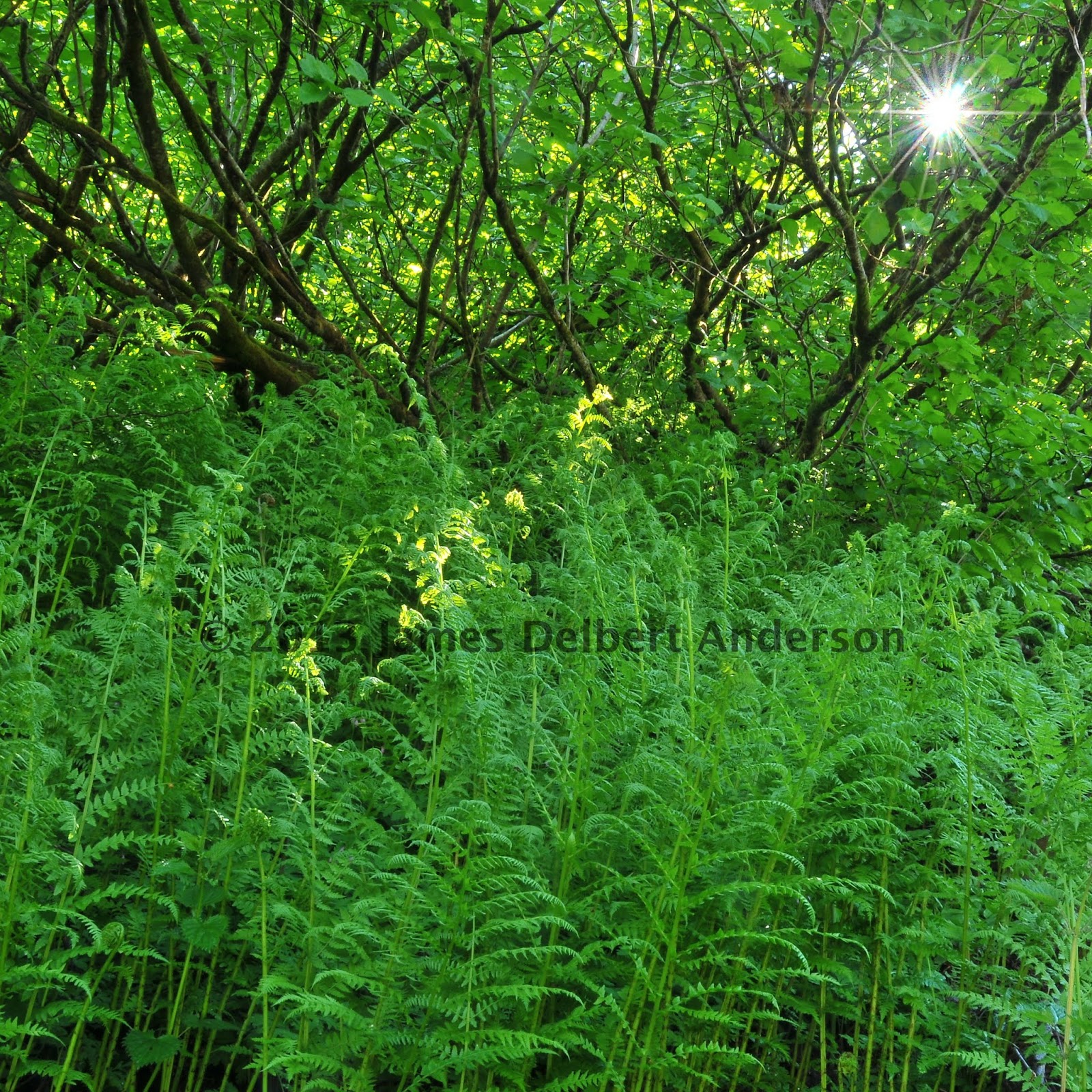
The next two impart a strong feeling of growth, I think. They were both taken at f/25 - the narrower aperture, combined with hiding the sun partially behind a branch, enabled me to get the starring effect you see below.


Wednesday, June 26, 2013

If You Can't Beat Them, Include Them


I’ll begin by apologizing, mostly in advance, for the sporadic nature of my posts this summer. My living situation currently does not include Internet access, so there will sometimes be a bit of a delay between a given photo shoot and my subsequent blog post.

Anyway, this post comes to you from Woodstock Farm and the adjacent Interurban Trail near Bellingham. I was hoping the Farm would be perhaps analogous to Discovery Park, at least in terms of floral diversity and views. Alas, it was small, with few flowery areas, few views, and no good views toward the sunset in the northwest (which was blocked a hill or spit or something anyway).

I went out on a bit of a limb for the first picture (actually, the last I took...as usual, I'm going out of order) because I disregarded a rule that I usually follow – I included the sky in a forest composition. I did so mostly because there was no way to exclude it and still position the other elements (i.e. the berries) the way I wanted them. The result was better than I expected – the golden hue of the sunset clouds actually appears, rather than appearing as washed-out splotches of white. Since my camera was metering for the green, I had to respectfully ask my camera to underexpose the image to preserve more golden sky color; the image you see below was the most overexposed of the bunch (which is unusual; I usually don't post extremes). I'm sure the Zone System would have made my exposure of this scene more efficient. I am not yet proficient with the Zone System, mostly because my camera's metering system is pretty good, and where it has failed I have squeezed by on intuition and luck. Soon, though, I will endeavor to learn the Zone System.


The second represents an early attempt to fulfill a New Year's resolution I made - to experiment with including the sky in more of my compositions. There are a few things to like about the image below: the filtered sunlight coming from the right illuminates the blooming ocean spray nicely, and I like the horizontal and diagonal lines provided by the clouds. Overall, though, the image is a bit "flat" in terms of contrast. This is an easy fix, though. The clouds also looked "bluer" and a bit more dramatic to the naked eye; editing from RAW could help with this problem as well.


Sunday, June 16, 2013

Back To Square One

Normally, the photos you see here are presented either at their original ratio (about 2x3) or cropped a bit to 8x10. Yesterday, though, I took a trip to Discovery Park, and upon returning, I realized that some of the images were compositionally better suited to being cropped to a square shape.

Also, in other exciting news, fireweed are beginning to bloom in and around Seattle! Careful followers of this blog will remember that this is my favorite type of flower. Most of the plants have not bloomed yet, but in gardens and parks a few pioneering flowers can be seen. One such specimen is featured in the first image of this post.

Back on topic, the first image is also one of the ones that I am presenting in a square aspect ratio. This is because the square crop suits the shape of the flower; other than it and the adjacent sun peeking out from behind it, there is little of interest in the image. So why include it?

I used an aperture of f/14 - although I would have liked to blur the background even more than I did, you need to narrow the aperture in order to produce the sun rats that you see here; at wider apertures, the sun looks like more of a roundish blob (which is fine in some compositions, but not how this one needed to turn out). The sun was already partially obscured by the trees in the background, and I obscured it even more with the the flower and leaves in the foreground. Thus only a quite small bit of the sun was actually directly shining on the camera. This was good (1) because this cut down on lens flare, of which there are only a couple small spots; and (2) because this enabled me to expose for the flower without blowing out the sun or the background highlights. There is still lens flare, but the areas are small enough that I might be able to deal with at least some of them with a bit of Lightroom wizardry.


Here's another one; in this case, the square crop was due to the arrangement of buds on the stalk. The original photo was vertically oriented; a different crop (e.g. 8x10) would have created too much dead space above and below the foreground buds.

I used an aperture of f/16 to show some detail in the fireweed flowers in the background; I wanted to juxtapose the foreground buds against them. This choice ran the risk of making the image to busy; I don't think that it did, though. In editing, some brightening of the foreground buds, since they are all mostly shadowed, might help the image.


The next two pictures are presented at more standard aspect ratios. The first is of a yarrow flower. The background is very grassy, and I initially experimented with narrow apertures in an attempt to incorporate their vertical lines into the composition. None of these attempts was very convincing, however, so I tried a wider aperture instead. I liked this much better, and liked the soft color gradient that the grass and intermittently visible blue sky produced. I also liked the soft lighting, filtered by grass out of frame, that was falling on the flower.


The last image is also of yarrow; I wanted a picture that juxtaposed it against the Puget Sound and the Olympics. This image did not quite live up to my hopes; even at f/40, the Olympics are only somewhat discernible. Still, I like the way the grass and the Sound fill in the background. I'm posting at a basic 8x10 crop, but I'm thinking that a crop closer to the original 2x3 might serve the image well - I would shrink it a bit, eliminating the out-of-focus yarrow flowers at the bottom and make the image more aligned with the rule of thirds. Perhaps.


Tuesday, June 11, 2013

A Good Old-Fashioned, Honest-To-Goodness Sunrise Trip

Recently I went on a sunrise trip to Magnuson Park, and while I didn't necessarily walk away with any fabulous images, I found some interesting ideas to work with.

When I shot the sunrise itself, I tried two angles. I'm actually going to go out of order, and present the best first, as is my custom. What this one really needs is some contrast work to cut some of the golden glare - not completely, but enough to enhance the green and purple colors in the foreground. The top of the frame is a bit overexposed as well. This was somewhat intentional, as I wanted to sacrifice some detail in the highlights in order to bring out the flowers. I'll have to play with the contrast in post-processing and, ultimately, make the judgment from a print rather than from a computer display.

Also, there were a couple of lens flares in the image. I used Picasa's retouching feature to edit them out. It is rather clumsy compared to Lightroom's options, so if you look closely you might find the edits.


The second one, which I had taken perhaps a minute earlier, is a mixed bag. I like the lighting a lot better - the lower sun created less glare, and facilitated a relatively more even exposure of the foreground and the sunrise.  I don't like the composition, though - the in-focus flowers are too close to dead center. This wouldn't be a problem if the composition were more symmetrical, but it's not. There's too much dead space on the right.


Next is one of my better vetch images to date; it is hard to photograph these flowers in a way that isn't busy. The immediately-after-sunrise lighting adds a rich color to the flower. I shot this at f/14; in retrospect, it might have helped the image to go a little wider than that and blur the background just a bit more.


Finally, an experimental grass shot. I like the idea, but wish I had shown the two grass heads in the lower foreground more prominently. The contrast is also a bit high; the foreground detail doesn't show well. Still, I like this perspective, and will have to play with this idea in the future.


Tuesday, June 04, 2013

Fiery Angels


Some photographers will say that, on a sunny day, it is only worth photographing within about an hour of sunset or sunrise. While the light is indeed best at this time, this is an unnecessarily restrictive rule. A more useful rule of thumb that I've encountered - I can't remember where - is that is your shadow is as long as or longer than you are tall, the light is good enough to make photography worthwhile. Even this   isn't a hard and fast rule, but it's proved the most useful guideline for sunny-day photography in my experience.


Hence my trip to Magnuson Park on a recent evening to experiment with the light. The first pictures I took - of backlit clover flowers - were what inspired this post's title. It was earlier in the evening when I took this image, so the sunlight was still a little harsh. Fortunately, a tree between the flower and the sun diffused the light a bit. I was attracted to the way the backlighting was illuminating the flower's outline. The backlighting gives the flower a kind of ethereal aura, but the flower - with the lighting and the shape of the petals - also looks a bit fiery. Hence the title of the post.


The next flower kept throbbing violently in the breeze (another pitfall of close-up photography in the late afternoon/evening). The flower is a vetch of some kind. By the time I got a shot that worked, the attractive lighting that had been falling on it was mostly gone. Still, I like the shot. In retrospect, I could have used a wider depth of field than f/4.5 gave me, but I didn't want to give up any more shutter speed.


With this flower, it was a similar story. My only sharp shots were after the lighting had disappeared - this time, my sharpness difficulties were due to the fact that I was using my mini-tripod as a monopod (a role that it is not designed to do), with the legs bunched together. But it's a nice shot. I could not find this in my flower book; I'll continue to search.


The rose below was the last image I took yesterday; I was attracted to the soft, speckled sunlight falling on the flower. I included leaves on all sides of the flower to try to incorporate them into the composition (rather than eliminate them as a distraction, which would have been difficult given their abundance here). A square crop of this image would probably reinforce this further. The out-of-focus leaves in the upper right add depth.


This last one comes from one of the park's wooded paths. I tried this both with and without a graduated ND filter; the one you see here was the one without. I tried using the filter so that I could rescue some of the highlights in the upper half of the frame from overexposure. Ultimately, though, the cottonwood trunks ended up too dark relative to the lower half of the frame, and the filter's presence was both obvious and distracting. Besides, in a photo like this, some blown highlights aren't the end of the world, I suppose. I used an aperture on the narrower side (f/14) to keep everything in focus and star the sun. I would have gone even narrower, but the grass was moving in the wind and I didn't want to have to use any longer of a shutter speed than I did (1/20 sec).