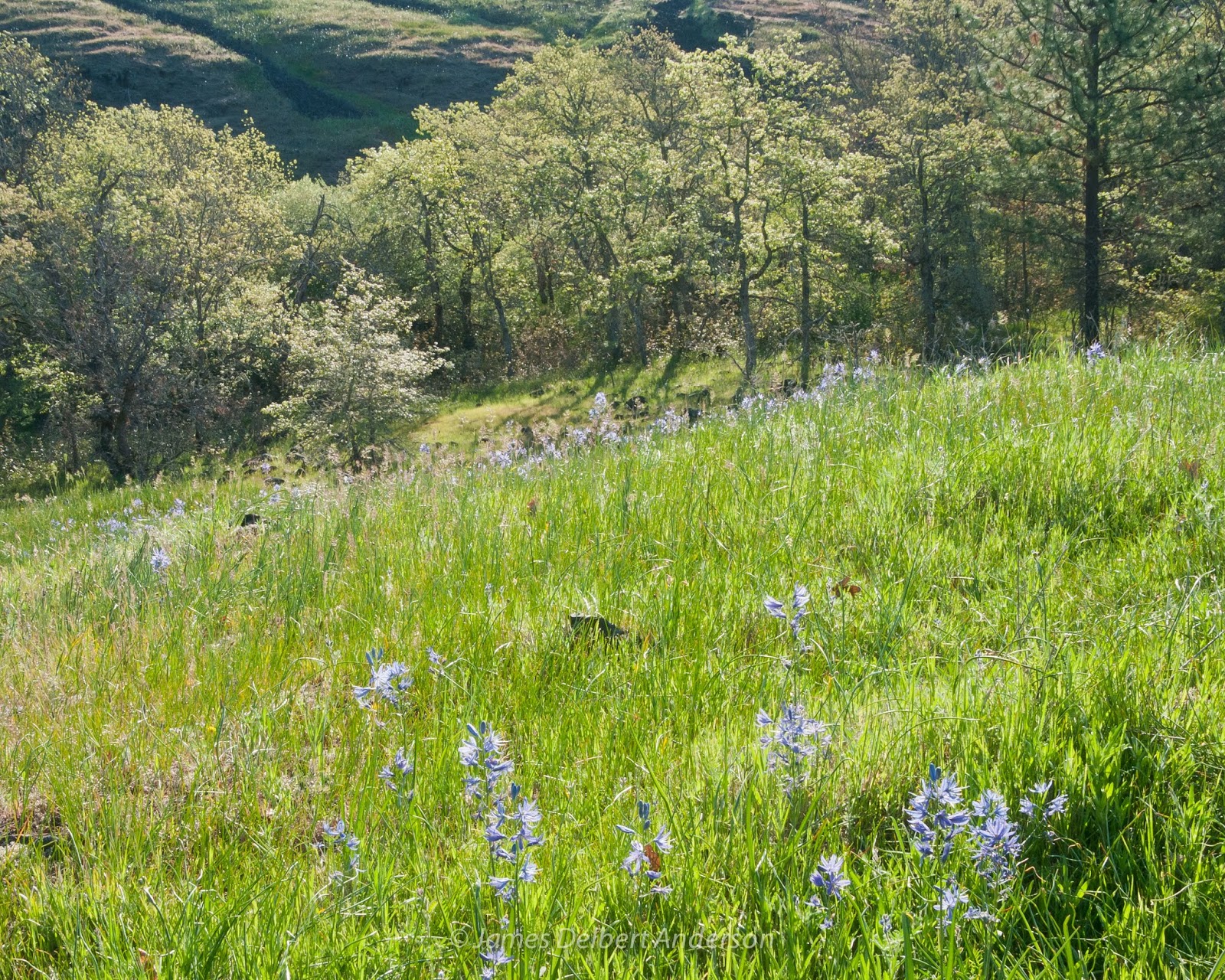
After camping in the Columbia Gorge in late April, my next photography trip was in early May, to Sares Head in Sharpe Park and Lighthouse Point in Deception Pass State Park, both on Fidalgo Island. This part of the state is one of my favorite local areas for wildflower viewing, and this trip didn't disappoint.
To begin, here's a closeup that I'm particularly fond of: broadleaf stonecrop (Sedum spathulifolium), from Lighthouse Point. The red color in the background comes from the leaves. F/5.
Here's a slightly wider view of the same flower. This image isn't quite as aesthetically striking as the one above, but you see more of the patterns of color from the flower clusters and leaves. F/6.3.
Next, fawn lily (Erythronium oreganum) near Sares Head. I've photographed fawn lily before, with some success. In this instance, however, I like the simplicity of this composition, and the contrast between the white flower and the dark green background. As I was shooting in low light (under forest cover early in the morning) and used a higher ISO, the noise is a bit high and the image quality isn't quite ideal. Still, I think it's good enough for some print sizes. F/5.6.
Here's my favorite landscape of the day: looking roughly northwest from Sares Head in Sharpe Park, with camas blooming in the foreground. F/18. The camas flowers are a bit small in the frame, although this might be less of a problem at a large print size (versus viewing it on a computer or phone screen). F/18.
Finally, here's a selective-focus rendition of the camas at Sares Head. F/5.
It will likely be a while until my next post, as I have a lot of pictures to sort, from a camping trip to eastern Washington and a day trip to Mount Rainier National Park. Best wishes until then!
Thursday, May 30, 2019
Tuesday, May 28, 2019
Spring Break Part 4: Latourell Falls
The last destination of the late April trip to the Columbia Gorge was Latourell Falls in Oregon. Of all the locations I visited, this was by far the most crowded. But the crowds were never thick enough to preclude photography, and it was fun to see the diverse cohort of trail users and their activities: nature photography, selfie-taking of varying styles and levels of seriousness, family and pet outings, and pure enjoyment of the scenery, to name just a few examples.
The image below is easily my favorite from the day: the lower falls framed by maple trees with newly opening leaves. F/18, 1/2 second.
Here's a wider view of the lower falls. The sense of depth isn't as compelling, but the composition shows the falls in a wider context. F/16, 0.4 seconds.
Next, two views of the upper falls. I found this location more difficult to photograph than the lower falls, due to the high contrast between the brightest parts of the waterfall and shadowed areas of cliffs and conifer trees. The images below, my best results, are marginal in that regard; there are some overexposed areas, but they might still look okay in print. I think the vertical composition is my favorite of the two, as the falls has a more prominent position. Both F/18, 0.6 seconds.
That's all for my Spring Break trip. Coming soon: a subsequent trip to Fidalgo Island to see some wildflowers!
The image below is easily my favorite from the day: the lower falls framed by maple trees with newly opening leaves. F/18, 1/2 second.
Here's a wider view of the lower falls. The sense of depth isn't as compelling, but the composition shows the falls in a wider context. F/16, 0.4 seconds.
Next, two views of the upper falls. I found this location more difficult to photograph than the lower falls, due to the high contrast between the brightest parts of the waterfall and shadowed areas of cliffs and conifer trees. The images below, my best results, are marginal in that regard; there are some overexposed areas, but they might still look okay in print. I think the vertical composition is my favorite of the two, as the falls has a more prominent position. Both F/18, 0.6 seconds.
That's all for my Spring Break trip. Coming soon: a subsequent trip to Fidalgo Island to see some wildflowers!
Friday, May 24, 2019
Spring Break Part 3: Coyote and Catherine
Next on the Columbia Gorge itinerary were the Coyote Wall (Moab-Maui loop) and Catherine Creek areas, which are on the Washington side, a few miles east of White Salmon. It's an incredibly scenic region. The Moab-Maui loop travels along Coyote Wall, very near the cliffs of the Wall itself, and through wide meadows looking toward the Columbia River and Mount Hood. The Catherine Creek area sports similar expansive meadows, but also features the lusher, woodsier environment around the creek. I spent one morning on the Moab-Maui loop and one at Catherine Creek, but could have spent much longer admiring the wildflowers and exploring the trails system.
Coyote Wall
I came away from the Moab-Maui loop with three good landscapes. The first looks over Coyote Wall itself, and the others over the surrounding landscape, with the Columbia River in the background of the third. As you can see, desert parsley (genus Lomatium) was the main attraction of the day, florally speaking. The variety featured in these images may be Lomatium grayi, or Gray's desert parsley, though I am not completely sure. All three F/18.
Catherine Creek
I'm pretty sure the flower in this first closeup is a variety of fiddleneck (genus Amsinckia). Due to the small size of this plant and other characteristics, I would guess it to be Amsinckia menziesii, although I am not completely sure. F/5.
Next, chocolate lily or checker lily (Fritillaria affinis). This was the first time I've ever been able to photograph this interesting flower! I found it growing in open woods immediately next to the trail. F/5.
Coyote Wall
I came away from the Moab-Maui loop with three good landscapes. The first looks over Coyote Wall itself, and the others over the surrounding landscape, with the Columbia River in the background of the third. As you can see, desert parsley (genus Lomatium) was the main attraction of the day, florally speaking. The variety featured in these images may be Lomatium grayi, or Gray's desert parsley, though I am not completely sure. All three F/18.
Catherine Creek
I'm pretty sure the flower in this first closeup is a variety of fiddleneck (genus Amsinckia). Due to the small size of this plant and other characteristics, I would guess it to be Amsinckia menziesii, although I am not completely sure. F/5.
Next, chocolate lily or checker lily (Fritillaria affinis). This was the first time I've ever been able to photograph this interesting flower! I found it growing in open woods immediately next to the trail. F/5.
Finally, here's a landscape from the area, looking over camas (Camassia quamash) flowers into the lush ravine of Catherine Creek itself. Despite the harsh backlighting, I think this one works. F/18.
Strong breezes kicked up during the morning hours, limiting my photography time. Even the images above were difficult to pull off; by lunchtime, with the breezes and high sunshine, my photography time was over.
Stay tuned for Part Four, which will feature Oregon's impressive Latourell Falls!
Monday, May 20, 2019
Spring Break Part 2: Tom McCall Preserve
Hello readers; it's been a while! I've been away from this blog due to another multiday photography trip, along with other events. But I'm looking forward to getting back on track, starting where I left off during the late April camping trip to the Columbia Gorge area.
On the second day of that trip, I visited the Tom McCall Preserve in Oregon, hiking to McCall Point from the Rowena Crest Viewpoint. Skies were crystal clear, and the sunlight created challenges with lighting and contrast, particularly as I approached the summit and the sun was high. On the other hand, views of the surrounding topography, including Mount Hood and Mount Adams, were excellent. Because of these factors and breezes tossing the flowers about, I concentrated on landscapes and forwent flower closeups. Balsamroot (genus Balsamorhiza) was in full bloom throughout much of the hike; moreover, there was a plethora of other flowers, including paintbrush, larkspur, and others.
First, my favorite from the day, probably because the lighting is the most interesting (this was the earliest of my photos; I took it before 9am). I had to contend with the uneven sky polarization that can happen with polarizing filters and wide angle lenses, but I don't think that's all bad: a tasteful amount of it can accentuate the early-morning feel of an image. The editing here is a work in progress, but it's coming along. F/18.
Next, three floral landscapes set against mountains in the background - Mount Hood in the first and third of this set, Mount Adams in the second. The first has a harmonious composition and a good sense of open space, and the flowers don't dwarf the mountain. It'd be good at a large size. The second has the most striking sense of depth. The third has the most interesting color variety, but I had some issues with image quality and distortion. F/18, F/18, and F/20, respectively.
Finally, a hillside view from close to midday. Due to the angle of the sun, the lighting isn't very interesting, but I liked the layered appearance of the landscape. I had passed this vantage point earlier in the day, with better lighting, but couldn't avoid casting my own shadow into the composition at that time. F/18.
That's all for today. Part 3 will include further wildflower adventures - including closeups! Stay tuned!
On the second day of that trip, I visited the Tom McCall Preserve in Oregon, hiking to McCall Point from the Rowena Crest Viewpoint. Skies were crystal clear, and the sunlight created challenges with lighting and contrast, particularly as I approached the summit and the sun was high. On the other hand, views of the surrounding topography, including Mount Hood and Mount Adams, were excellent. Because of these factors and breezes tossing the flowers about, I concentrated on landscapes and forwent flower closeups. Balsamroot (genus Balsamorhiza) was in full bloom throughout much of the hike; moreover, there was a plethora of other flowers, including paintbrush, larkspur, and others.
First, my favorite from the day, probably because the lighting is the most interesting (this was the earliest of my photos; I took it before 9am). I had to contend with the uneven sky polarization that can happen with polarizing filters and wide angle lenses, but I don't think that's all bad: a tasteful amount of it can accentuate the early-morning feel of an image. The editing here is a work in progress, but it's coming along. F/18.
Next, three floral landscapes set against mountains in the background - Mount Hood in the first and third of this set, Mount Adams in the second. The first has a harmonious composition and a good sense of open space, and the flowers don't dwarf the mountain. It'd be good at a large size. The second has the most striking sense of depth. The third has the most interesting color variety, but I had some issues with image quality and distortion. F/18, F/18, and F/20, respectively.
Finally, a hillside view from close to midday. Due to the angle of the sun, the lighting isn't very interesting, but I liked the layered appearance of the landscape. I had passed this vantage point earlier in the day, with better lighting, but couldn't avoid casting my own shadow into the composition at that time. F/18.
That's all for today. Part 3 will include further wildflower adventures - including closeups! Stay tuned!
Thursday, May 02, 2019
Spring Break Part One: Falls Creek Falls
Hello! I recently returned from a multi-day car camping trip in the Columbia River Gorge area, where I was able to hike trails on both the Washington and Oregon sides. I'll be posting my photography over the next couple of weeks as I have time.
My first destination was Falls Creek Falls, via the Lower Falls Creek Trail in Washington's Gifford Pinchot National Forest. I timed my visit for what turned out to be the only solidly overcast day of the trip. Even with this favorable lighting, I had challenges with contrast. In most cases, I erred on the side of underexposure to preserve detail in highlights (especially in waterfalls/rapids). This led to more noise and less sharpness in darker areas than would be ideal. Nevertheless, I've had success with images in print with poorer image quality and sharpness, so here goes!
First, the falls at the end of the trail. Spray from the waterfall made photography challenging; the volume of water hitting my lens (and camera backpack) was similar to what I might encounter in a rainstorm strong enough to preclude photography. Nevertheless, I took out my lens cleaning cloths and soldiered on. The composition below is my favorite result; the complex waterfall and cedar tree at right made the incessant lens-wiping worthwhile. F/18, 0.4 seconds.
The day held plenty of other lovely attractions, however, including nice scenery along the rest of the trail. Here's a view of Falls Creek from roughly halfway along the trail. I thought the split in the creek might be visually interesting, particularly set against all the mossy branches. F/18, 1.6 seconds.
Next, another view of Falls Creek, with mossy branches in the foreground. I think this idea was more interesting in my mind's eye than in execution. Nevertheless, I thought I'd post the result. It might be more interesting enlarged as a print; the creek might come through more clearly. F/20, 0.6 seconds.
Later in the day, I visited the nearby Panther Creek Falls. I wasn't particularly thrilled by my compositions with a wide depth of field; the different green elements were indistinct from one another, and I had a hard time conveying a sense of scale. The image below, however, is interesting, with the falls out of focus and framed by cedar branches. With the slow shutter speed required by the low light (1/6 second), I had a hard time freezing the branches in the breeze. This is my best result, and I think it's sharp enough to be acceptable in print, at least at some sizes. I know that in my year-in-review posts, I've expressed a desire to try more compositions with a narrow depth of field. F/6.3.
Tha's all for now. Stay tuned for some wildflowers!
My first destination was Falls Creek Falls, via the Lower Falls Creek Trail in Washington's Gifford Pinchot National Forest. I timed my visit for what turned out to be the only solidly overcast day of the trip. Even with this favorable lighting, I had challenges with contrast. In most cases, I erred on the side of underexposure to preserve detail in highlights (especially in waterfalls/rapids). This led to more noise and less sharpness in darker areas than would be ideal. Nevertheless, I've had success with images in print with poorer image quality and sharpness, so here goes!
First, the falls at the end of the trail. Spray from the waterfall made photography challenging; the volume of water hitting my lens (and camera backpack) was similar to what I might encounter in a rainstorm strong enough to preclude photography. Nevertheless, I took out my lens cleaning cloths and soldiered on. The composition below is my favorite result; the complex waterfall and cedar tree at right made the incessant lens-wiping worthwhile. F/18, 0.4 seconds.
The day held plenty of other lovely attractions, however, including nice scenery along the rest of the trail. Here's a view of Falls Creek from roughly halfway along the trail. I thought the split in the creek might be visually interesting, particularly set against all the mossy branches. F/18, 1.6 seconds.
Next, another view of Falls Creek, with mossy branches in the foreground. I think this idea was more interesting in my mind's eye than in execution. Nevertheless, I thought I'd post the result. It might be more interesting enlarged as a print; the creek might come through more clearly. F/20, 0.6 seconds.
Later in the day, I visited the nearby Panther Creek Falls. I wasn't particularly thrilled by my compositions with a wide depth of field; the different green elements were indistinct from one another, and I had a hard time conveying a sense of scale. The image below, however, is interesting, with the falls out of focus and framed by cedar branches. With the slow shutter speed required by the low light (1/6 second), I had a hard time freezing the branches in the breeze. This is my best result, and I think it's sharp enough to be acceptable in print, at least at some sizes. I know that in my year-in-review posts, I've expressed a desire to try more compositions with a narrow depth of field. F/6.3.
Tha's all for now. Stay tuned for some wildflowers!
Monday, April 15, 2019
Spring at Saint Edward
Last week, I made a quick weekday jaunt to Saint Edward State Park during my off hours. Rain fell during most of my visit, but I managed to walk away with a couple satisfactory compositions, all attempts of the Puget Sound Convergence Zone to soak my gear notwithstanding.
First, a salmonberry flower (Rubus spectabilis), with the trunks of bigleaf male and other trees in the background. The bigleaf maple trees were in the process of blooming and leafing out; the pale yellowish-green of their flowers and new leaves contrasted nicely with the lush green of the salmonberry leaves in the foreground. I've tried compositions along these lines in prior years, and this is my best to date. The noise is a bit high, but I think at standard print sizes (say, 8x12), this would look fine. F/10.
Next, a closeup of an inflorescence on a bigleaf maple (Acer macrophyllum). I consider myself fortunate that I found one that I was able to photograph - these flower clusters are frequently too high to photograph well (even for me!). Still working on perfecting the lighting and contrast, but this one's getting there. F/5.6.
First, a salmonberry flower (Rubus spectabilis), with the trunks of bigleaf male and other trees in the background. The bigleaf maple trees were in the process of blooming and leafing out; the pale yellowish-green of their flowers and new leaves contrasted nicely with the lush green of the salmonberry leaves in the foreground. I've tried compositions along these lines in prior years, and this is my best to date. The noise is a bit high, but I think at standard print sizes (say, 8x12), this would look fine. F/10.
Next, a closeup of an inflorescence on a bigleaf maple (Acer macrophyllum). I consider myself fortunate that I found one that I was able to photograph - these flower clusters are frequently too high to photograph well (even for me!). Still working on perfecting the lighting and contrast, but this one's getting there. F/5.6.
Tuesday, March 26, 2019
Wildflower Season begins!
Yes, it's the best time of year, folks! I hiked Goose Rock in Deception Pass State Park on Sunday, and the wildflowers were out. I was hoping to see some grass widow (Olsynium douglasii), and although I didn't spot any along the trails I hiked, a few other early-blooming species were there to greet my macro lens as I brought it out for the first time this year.
We'll start with those wildflower closeups! First, small-flowered prairie star, or woodland star (Lithophragma parviflorum). I've photographed this species before, but really like how this composition turned out. F/6.3.
Next, red-flowering currant (Ribes sanguineum). I have other closeups of these as well, but I like the bright colors in this composition, as well as the exuberant chaos of the inflorescence. I avoided symmetry in this one, which I think paid off. F/5.6.
Third, what I believe is small-flowered blue-eyed Mary (Collinsia parviflora). Don't let this image fool you - these flowers are very small and easy to miss in the rocky meadows! This image was a challenge. Every spring, I forget how difficult it can be to perfect the focus point in a wildflower closeup, particularly if any breeze is present - or, as in this case, the flower is at a height not covered by my tripods and I have to shoot handheld. (My patient hiking companion waited as I made more than sixty attempts! She knew what she was getting into, but I'm still grateful.) F/6.3.
Finally, a landscape view from the summit of Goose Rock, looking essentially west toward Deception Island. The filtered-sunshine lighting at roughly 10am wasn't all that interesting, but the contrast was manageable, and there was still enough blue in the sky to include some of it in the composition. F/18.
Happy spring, everyone!
We'll start with those wildflower closeups! First, small-flowered prairie star, or woodland star (Lithophragma parviflorum). I've photographed this species before, but really like how this composition turned out. F/6.3.
Next, red-flowering currant (Ribes sanguineum). I have other closeups of these as well, but I like the bright colors in this composition, as well as the exuberant chaos of the inflorescence. I avoided symmetry in this one, which I think paid off. F/5.6.
Third, what I believe is small-flowered blue-eyed Mary (Collinsia parviflora). Don't let this image fool you - these flowers are very small and easy to miss in the rocky meadows! This image was a challenge. Every spring, I forget how difficult it can be to perfect the focus point in a wildflower closeup, particularly if any breeze is present - or, as in this case, the flower is at a height not covered by my tripods and I have to shoot handheld. (My patient hiking companion waited as I made more than sixty attempts! She knew what she was getting into, but I'm still grateful.) F/6.3.
Finally, a landscape view from the summit of Goose Rock, looking essentially west toward Deception Island. The filtered-sunshine lighting at roughly 10am wasn't all that interesting, but the contrast was manageable, and there was still enough blue in the sky to include some of it in the composition. F/18.
Happy spring, everyone!
Subscribe to:
Posts (Atom)