Yesterday, I continued my ongoing adventures in physical recovery and getting back into the swing of photography by making the hike to Cascade Pass in North Cascades National Park. For the level of mountain scenery that you can access, it's a relatively easy trek. Switchbacks are always a bit of a chore, but here they mostly go through pleasant forest at a manageable grade.
The first two images are from the trailhead parking lot. Even there, as you see, the views are impressive. At some point, I'd like to camp at one of the campgrounds in the area and do some photography along the Cascade River Road itself.
The next one is a view southeast-ish from the pass itself. In addition to the curvature of the basin, I was really struck by all the different colors on the ground.
Next are a couple views northwest-ish, looking back over the Cascade River drainage.
In this one, I wanted to contrast some of the shrubs near the trail with the cliffs and streams opposite. It ended clearing up a bit when I was at this spot, so the sunlit shrubs resulted in a higher contrast than I'd originally envisioned. Nevertheless, I think the cliffs etc. in the background are discernible enough to make this work.
This one features some pearly everlasting (Anaphalis margaritacea) in the foreground with the Cascade River valley in the background. I don't know whether those flowers provide a sufficiently distinctive or compelling foreground, but perhaps adjustments to the lighting and contrast would help.
Lastly, an image in which I wanted to frame the forest against the colorful mountainsides beyond. I am unsure whether the cliffs are quite distinct enough - it was hard to expose for both the dark tree in the foreground and the lighter background. This one may take some tasteful experimentation with lighting and contrast in Lightroom.
Saturday, September 17, 2016
Tuesday, September 06, 2016
Hints of Autumn
Soooo. My ongoing battle with my back/neck injury has prevented much in the way of photography over the past few weeks, which is a bummer since I missed a lot of summer in the Cascades high country. I've been doing some exercises at home, though, and am hopefully on the mend now.
Yesterday, I visited the Baker River trail to assess my current physical state. It was a good trail for this purpose because it's not too physically challenging, but it's scenic enough to be a satisfying destination in its own right (one I've visited many times before). It's one of the best old-growth forest hikes that I've experienced.
This was the first time I'd been here in the autumn. Forest landscapes are always a bit tricky, as I've described before, as it's difficult to isolate subject matter or find compelling color contrasts. Autumn, with the changing of color, can make this a bit easier - although the leaves in wet forests around here sometimes turn a mottled brown rather than attractive colors.
The upside of the day was perfect weather for photography - generally overcast, light winds, and plenty of moisture on the trees and plants (this seems to bring out the colors). I did find a few spots where the autumn colors were nice enough to make for an interesting composition; there weren't too many distracting mottled or rotten leaves.
These first two are my favorites; they're from the section of the trail inside North Cascades National Park near the end. F/22 in both cases.
I'm not quite as convinced by this third one, from the national forest section; I don't know whether the contrast between the mossy trunk in the foreground and the forested background is strong enough. Nevertheless, I think it's worth posting, and does a good job of capturing the general character of the day. F/22.
Finally, here's one from the end of the trail at Sulphide Creek. I liked the lines that the deadwood had, and wanted to juxtapose that and the baby tree against the forest in the background. Despite the fact that the area is old-growth, there are many young sections of the forest, especially near the river and creeks, where flooding and washouts take out old trees and deposit islands or banks where young forests of alder, cottonwood, and willow grow. F/22.
Yesterday, I visited the Baker River trail to assess my current physical state. It was a good trail for this purpose because it's not too physically challenging, but it's scenic enough to be a satisfying destination in its own right (one I've visited many times before). It's one of the best old-growth forest hikes that I've experienced.
This was the first time I'd been here in the autumn. Forest landscapes are always a bit tricky, as I've described before, as it's difficult to isolate subject matter or find compelling color contrasts. Autumn, with the changing of color, can make this a bit easier - although the leaves in wet forests around here sometimes turn a mottled brown rather than attractive colors.
The upside of the day was perfect weather for photography - generally overcast, light winds, and plenty of moisture on the trees and plants (this seems to bring out the colors). I did find a few spots where the autumn colors were nice enough to make for an interesting composition; there weren't too many distracting mottled or rotten leaves.
These first two are my favorites; they're from the section of the trail inside North Cascades National Park near the end. F/22 in both cases.
I'm not quite as convinced by this third one, from the national forest section; I don't know whether the contrast between the mossy trunk in the foreground and the forested background is strong enough. Nevertheless, I think it's worth posting, and does a good job of capturing the general character of the day. F/22.
Finally, here's one from the end of the trail at Sulphide Creek. I liked the lines that the deadwood had, and wanted to juxtapose that and the baby tree against the forest in the background. Despite the fact that the area is old-growth, there are many young sections of the forest, especially near the river and creeks, where flooding and washouts take out old trees and deposit islands or banks where young forests of alder, cottonwood, and willow grow. F/22.
Friday, August 19, 2016
The lunatic is on the beach
It's been a while! I am in the ongoing process of recovering from an injury, which has put a damper on my photographic efforts. Earlier this week, however, I was able to squeeze out a trip to Larrabee State Park just south of Bellingham to catch a sunset and then the setting of the full moon the next morning. I like doing photography at Larrabee because it provides interesting subject matter beyond the mere western views: interesting rock formations for foregrounds, and views of islands to add to the background.
As usual, the images here are the unedited JPEGs. In all cases, they'll need some fine-tuning of the white balance, in addition to some cleaning up - dust spots on the lens were particularly prominent in this trip's compositions. Additionally, all of these are single exposures. The key to doing it this way in moon photography is monitoring the moon and sun both. In this instance, the moon set just after sunrise; thus, the moon was still up with just enough light in the sky to make the exposure settings all work. A side benefit is the cool sky color at sunrise.
My most dramatic image of the moon came right before it set. F/22. This is the best aspect ratio for the composition (cropped to 4x8), although something along the lines of 4x6 could also work.
The next two are wider views from just a bit earlier. They're similar, with the second being a wider focal length with more foreground; I'm not sure which I like better. F/22 in both cases.
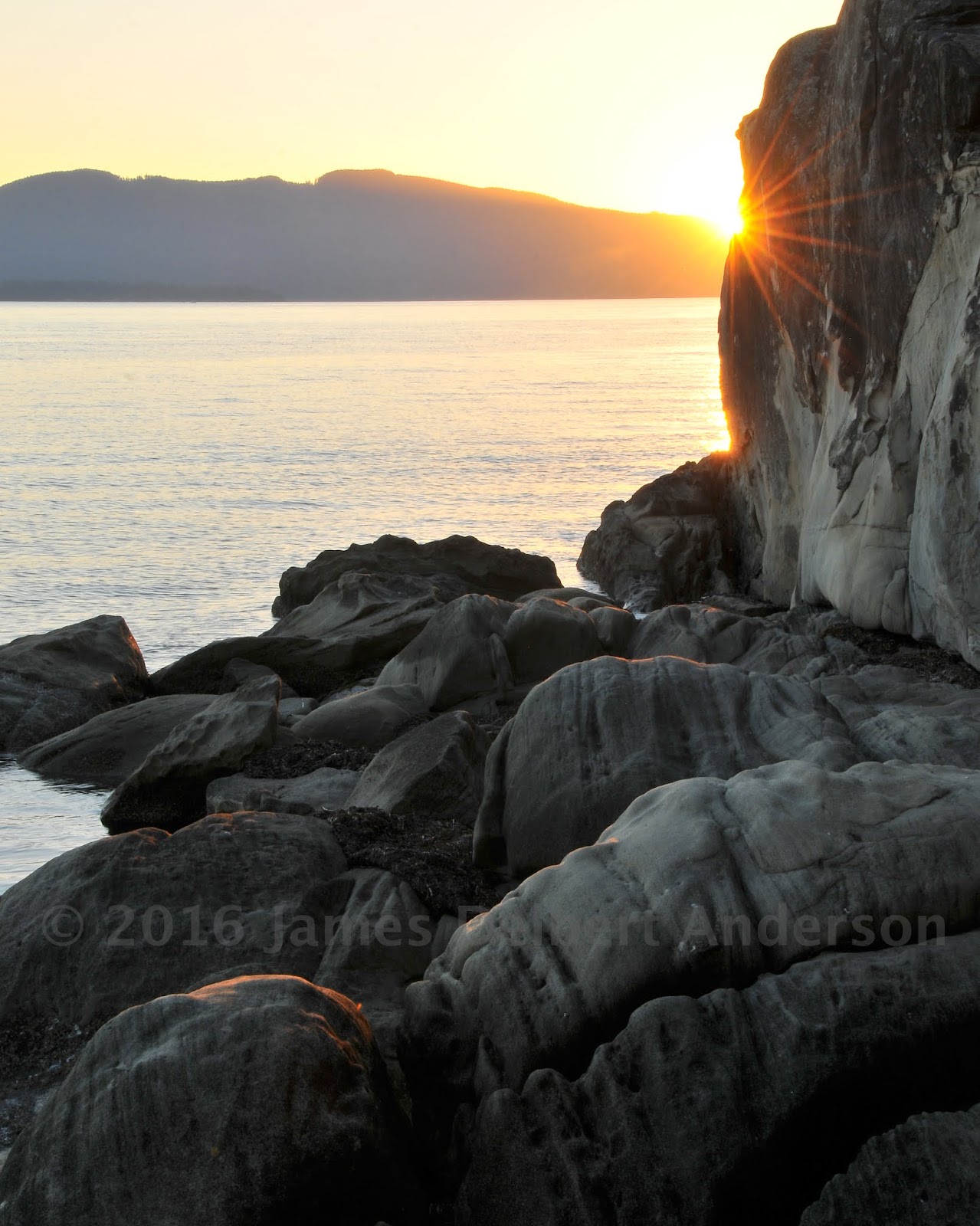
Here's one of the sunset the previous evening, with the park's interesting rock formations in the foreground. I've had good luck with horizontal sunset shots here before, but it's nice to have a vertical one as well. I believe the land form in the background is Lummi Island. F/22 produced the rays that you see coming from the sun; partially obscuring it behind the rock also helped enhance the rays (by making it even more of a point source of light) while reducing flares.
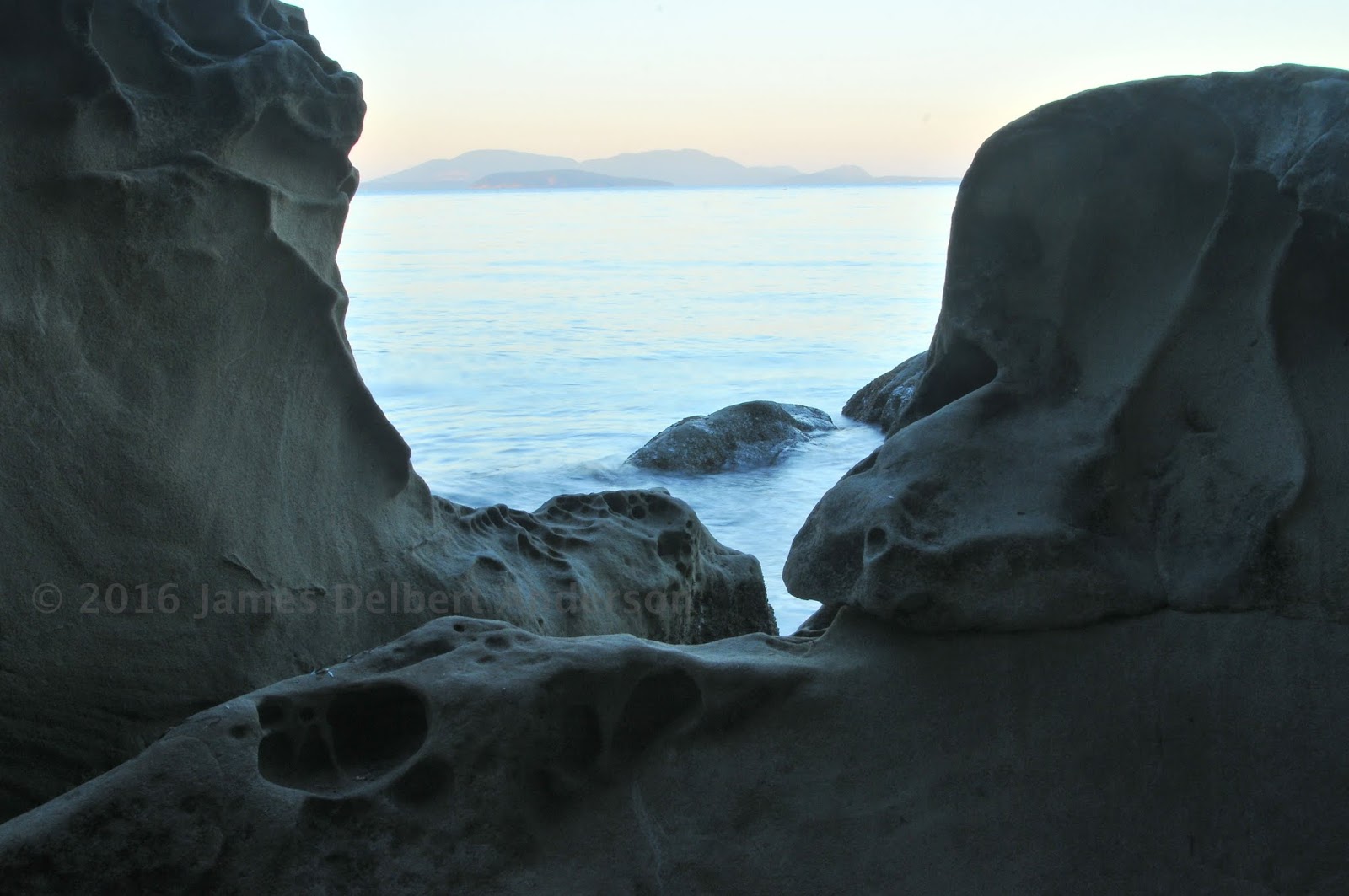
Finally, a couple other beach landscapes from early in the morning, both at f/22 again. I think the first one in particular has an interesting composition, and with some judicious lighting and color adjustments would work fairly well.
As usual, the images here are the unedited JPEGs. In all cases, they'll need some fine-tuning of the white balance, in addition to some cleaning up - dust spots on the lens were particularly prominent in this trip's compositions. Additionally, all of these are single exposures. The key to doing it this way in moon photography is monitoring the moon and sun both. In this instance, the moon set just after sunrise; thus, the moon was still up with just enough light in the sky to make the exposure settings all work. A side benefit is the cool sky color at sunrise.
My most dramatic image of the moon came right before it set. F/22. This is the best aspect ratio for the composition (cropped to 4x8), although something along the lines of 4x6 could also work.
The next two are wider views from just a bit earlier. They're similar, with the second being a wider focal length with more foreground; I'm not sure which I like better. F/22 in both cases.
Here's one of the sunset the previous evening, with the park's interesting rock formations in the foreground. I've had good luck with horizontal sunset shots here before, but it's nice to have a vertical one as well. I believe the land form in the background is Lummi Island. F/22 produced the rays that you see coming from the sun; partially obscuring it behind the rock also helped enhance the rays (by making it even more of a point source of light) while reducing flares.
Finally, a couple other beach landscapes from early in the morning, both at f/22 again. I think the first one in particular has an interesting composition, and with some judicious lighting and color adjustments would work fairly well.
Tuesday, July 19, 2016
Misery and the Blues
Well, I went and did it: a camping trip to the Blue Mountains of southeast Washington. I spent two nights at the Misery Spring Campground, which is roughly thirty miles south of Pomeroy. For the most part, I explored scenery along the roads near the campground. The sunny weather, while certainly welcome for tent camping, precluded much in the way of extensive day hiking - I needed to be situated to take pictures in the early morning and late evening. Thankfully, the forest roads did not disappoint, and the traffic was quite light; the road south from the campground in particular was very quiet made for a nice walk. In fact, it was from that road that I saw a herd of elk! First time I've seen elk in the wild!
The Blue Mountains are different from anywhere I've been. In terms of flora, they remind me a bit of the east slopes of the Cascades, with maybe a drier assortment of plants. The terrain is quite dissimilar, though, with broader ridges and plateaus and extensive river canyons. I'm hoping to do some reading this summer about the natural and cultural history of the Blue Mountains. In terms of culture, I'm sure the region has been and is significant to Native tribes, although I'm not familiar with specifics; I do know that U.S. settlers on the Oregon Trail dreaded the range, and sheep and cattle grazing began on the 19th century.
I've gotten slowed down identifying the plants from this trip. First, some of them are difficult for me as a nonspecialist to distinguish, such as varieties of aster. Second, my guides don't cover this region well. But I have at least a general idea of what most of them are, and may make some more specific discoveries and updates as time goes on.
First is the big prize - the view overlooking the Wenaha-Tucannon Wilderness from a viewpoint near the campground; in this image, the view is roughly southwest over the First Creek drainage. The flowers in the foreground are penstemon. The polarization of the sky is a bit uneven, but I think I can lighten the upper left part of the image. F/22.
Next are a couple views from Forest Road 40 over the Tucannon drainage. The first in this pair features paintbrush as the most prominent flower; the second, penstemon. F/22 in both cases.
The next pair consists of views from the same stretch of road early in the morning, when there was some interesting pink color in the sky. In present JPEG form, the color shows up better in the first image than in the second, although I think I could bring it out in both. F/22 in both cases.
The last view is looking more or less south from the viewpoint toward the Wallowa Mountains. F/18.
Now, a few landscapes other than the views. First is a view of a nice clump of paintbrush in an area that appears to have burned not long ago. F/29.
Next is a meadow of penstemon and other flowers. F/25.
Lastly, a few flower closeups. The first is aster. Note the rich color of the sky - one interesting aspect of photography at high altitudes is that the polarizing filter works more effectively. In some situations, you can make a clear sky look practically black. F/8.
Next is a penstemon. F/4.
Next is what I believe to be a buckwheat of some kind. F/4.
Finally, an opening flower that I haven't been able to identify but might be a knapweed. If so, it's likely an invasive plant, but I think it's cool picture. F/4.2.
The Blue Mountains are different from anywhere I've been. In terms of flora, they remind me a bit of the east slopes of the Cascades, with maybe a drier assortment of plants. The terrain is quite dissimilar, though, with broader ridges and plateaus and extensive river canyons. I'm hoping to do some reading this summer about the natural and cultural history of the Blue Mountains. In terms of culture, I'm sure the region has been and is significant to Native tribes, although I'm not familiar with specifics; I do know that U.S. settlers on the Oregon Trail dreaded the range, and sheep and cattle grazing began on the 19th century.
I've gotten slowed down identifying the plants from this trip. First, some of them are difficult for me as a nonspecialist to distinguish, such as varieties of aster. Second, my guides don't cover this region well. But I have at least a general idea of what most of them are, and may make some more specific discoveries and updates as time goes on.
First is the big prize - the view overlooking the Wenaha-Tucannon Wilderness from a viewpoint near the campground; in this image, the view is roughly southwest over the First Creek drainage. The flowers in the foreground are penstemon. The polarization of the sky is a bit uneven, but I think I can lighten the upper left part of the image. F/22.
Next are a couple views from Forest Road 40 over the Tucannon drainage. The first in this pair features paintbrush as the most prominent flower; the second, penstemon. F/22 in both cases.
The next pair consists of views from the same stretch of road early in the morning, when there was some interesting pink color in the sky. In present JPEG form, the color shows up better in the first image than in the second, although I think I could bring it out in both. F/22 in both cases.
The last view is looking more or less south from the viewpoint toward the Wallowa Mountains. F/18.
Now, a few landscapes other than the views. First is a view of a nice clump of paintbrush in an area that appears to have burned not long ago. F/29.
Next is a meadow of penstemon and other flowers. F/25.
Lastly, a few flower closeups. The first is aster. Note the rich color of the sky - one interesting aspect of photography at high altitudes is that the polarizing filter works more effectively. In some situations, you can make a clear sky look practically black. F/8.
Next is a penstemon. F/4.
Next is what I believe to be a buckwheat of some kind. F/4.
Finally, an opening flower that I haven't been able to identify but might be a knapweed. If so, it's likely an invasive plant, but I think it's cool picture. F/4.2.
Sunday, July 03, 2016
Gold Creek
Yesterday, I went to the Gold Creek trail near Snoqualmie Pass, taking advantage of the even overcast lighting in the morning. The advantage of the Gold Creek Trail is that there are some quite scenic sections early on that can be reached without too much effort, allowing me to get the most out of the early morning. Another advantage is that, compared to other trails along the I-90 corridor, it's lightly used. This gives me time to set my tripod on the trail and get a proper composition without tripping anyone.
Something unique about this trip was that I made frequent use of the heavy artillery - for I think the first three images, definitely the first and third, I used my ultra wide lens. Sometimes it feels a bit silly carrying it around, given that I use it far less often than the other lenses, but it can sure come in handy.
First, a shot looking across the valley with some tiger lilies in the background; this is near the beginning of the trail. Although you can't see all of the peaks in the distance, the clouds were starting to get interesting. With some tasteful touching up, the clouds would look even better. F/25.
Next is a little clump of some scarlet paintbrush from nearby. F/25.
Next, from farther along the trail, is a view of the hemlock forest that characterizes much of the valley. F/18.
The forest depicted above (which also includes other trees like silver fir) alternates with brushy areas filled with willows, vine maple alder, and wildflowers. Below is one such spot, with thimbleberry flowers in the foreground and Sitka valerian behind them. F/25.
Lastly, a new flower, at least to my photography: rosy twistedstalk, Streptopus roseus. F/3.8.
Something unique about this trip was that I made frequent use of the heavy artillery - for I think the first three images, definitely the first and third, I used my ultra wide lens. Sometimes it feels a bit silly carrying it around, given that I use it far less often than the other lenses, but it can sure come in handy.
First, a shot looking across the valley with some tiger lilies in the background; this is near the beginning of the trail. Although you can't see all of the peaks in the distance, the clouds were starting to get interesting. With some tasteful touching up, the clouds would look even better. F/25.
Next is a little clump of some scarlet paintbrush from nearby. F/25.
Next, from farther along the trail, is a view of the hemlock forest that characterizes much of the valley. F/18.
The forest depicted above (which also includes other trees like silver fir) alternates with brushy areas filled with willows, vine maple alder, and wildflowers. Below is one such spot, with thimbleberry flowers in the foreground and Sitka valerian behind them. F/25.
Lastly, a new flower, at least to my photography: rosy twistedstalk, Streptopus roseus. F/3.8.
Friday, July 01, 2016
Discovery trip
Night before last, I had the pleasure of heading down to Discovery Park for evening/sunset. I wanted to take advantage of the calm conditions - Discovery Park can get quite breezy on summer evenings, I've found, making plant or flower foregrounds challenging. But for whatever reason, the weather pattern on Tuesday had produced a very calm evening, and I knew from forecasts that Wednesday was likely to be similar.
We'll start with the best image of the night, some dandelion seeds framed against the sunset. F/3.5. Waiting until just before the sun dipped below the horizon (well, the Olympic Peninsula) resulted in the rich yellow color.
And below is some yarrow with Puget Sound in the background. Why are the yarrow in some parts of Discovery Park so deeply pink, when they are white to whitish pink everywhere else? The ongoing mystery continues. F/18 to preserve some shape in the green bush in the background, as well as to clarify the outline of the Sound.
We'll start with the best image of the night, some dandelion seeds framed against the sunset. F/3.5. Waiting until just before the sun dipped below the horizon (well, the Olympic Peninsula) resulted in the rich yellow color.
And below is some yarrow with Puget Sound in the background. Why are the yarrow in some parts of Discovery Park so deeply pink, when they are white to whitish pink everywhere else? The ongoing mystery continues. F/18 to preserve some shape in the green bush in the background, as well as to clarify the outline of the Sound.
Thursday, June 23, 2016
Stuart Lake
I recently made a brief foray into Alpine Lakes Wilderness on the Stuart Lake trail. While I would have needed a permit to backpack in the area, day hiking is allowed if one fills out a little form at the trailhead. I chose the Stuart Lake trail because it seemed a good match for my current level of physical fitness. A month ago, I probably wouldn't have been able to handle even that. But thanks to more frequent walking and hiking, as well as some trips to the gym, I'm getting there. The trail itself is pleasant enough and not too rocky. There are some stretches that aren't so scenic, but the highlights definitely make up for it.
We'll start with the view from a clearing a few miles in, with some aspen trees in the foreground. I believe that the peak on the left is Argonaut Peak, with Sherpa Peak on the right. This was actually the second time I tried photographing this particular viewpoint. On the way up, the lighting was more contrasty and the aspen trunks were shaded at this angle. But on my way back down the trail, the sunlight fell on the aspen trunks, accentuating them more; additionally, the sunshine was more filtered, resulting in a more even exposure.
Here is a different composition of the same view, with more emphasis on the mountains.
Stuart Lake itself also has some nice views. Here's a view across the lake through some granite. I used f/22 to get both the granite and the lake/mountains in focus.
Finally, a view from early in the trail. I think this might be Mount Stuart itself. The sunlight was filtered a bit at the moment; even so, the highlights got a bit blown out. Not irreparably so, however.
I found some new wildflowers! The first is yellow or golden columbine, Aquilegia flavescens. I only noticed it on one spot along the trail, and I'm glad it caught my eye. F/3.8.
Next is what I believe to by showy Jacob's ladder, Polemonium pulcherrimum. F/3.8.
Finally, I believe these are pinedrops (Pterospora andromedea). I found these beside my campsite at Eightmile Campground. F/3.3.
Lastly, here are a couple views of Icicle Creek from Eightmile Campground, where I spent the night. They have an excessively bluish cast due to the fact that they were taken under clear skies, but that'll be easy enough to deal with. The highlight of the first is what I believe to be sulfur buckwheat, Erigonum umbellatum; the highlight of the second is an impressive ponderosa pine trunk.
We'll start with the view from a clearing a few miles in, with some aspen trees in the foreground. I believe that the peak on the left is Argonaut Peak, with Sherpa Peak on the right. This was actually the second time I tried photographing this particular viewpoint. On the way up, the lighting was more contrasty and the aspen trunks were shaded at this angle. But on my way back down the trail, the sunlight fell on the aspen trunks, accentuating them more; additionally, the sunshine was more filtered, resulting in a more even exposure.
Here is a different composition of the same view, with more emphasis on the mountains.
Stuart Lake itself also has some nice views. Here's a view across the lake through some granite. I used f/22 to get both the granite and the lake/mountains in focus.
Finally, a view from early in the trail. I think this might be Mount Stuart itself. The sunlight was filtered a bit at the moment; even so, the highlights got a bit blown out. Not irreparably so, however.
I found some new wildflowers! The first is yellow or golden columbine, Aquilegia flavescens. I only noticed it on one spot along the trail, and I'm glad it caught my eye. F/3.8.
Next is what I believe to by showy Jacob's ladder, Polemonium pulcherrimum. F/3.8.
Finally, I believe these are pinedrops (Pterospora andromedea). I found these beside my campsite at Eightmile Campground. F/3.3.
Lastly, here are a couple views of Icicle Creek from Eightmile Campground, where I spent the night. They have an excessively bluish cast due to the fact that they were taken under clear skies, but that'll be easy enough to deal with. The highlight of the first is what I believe to be sulfur buckwheat, Erigonum umbellatum; the highlight of the second is an impressive ponderosa pine trunk.
Subscribe to:
Posts (Atom)